
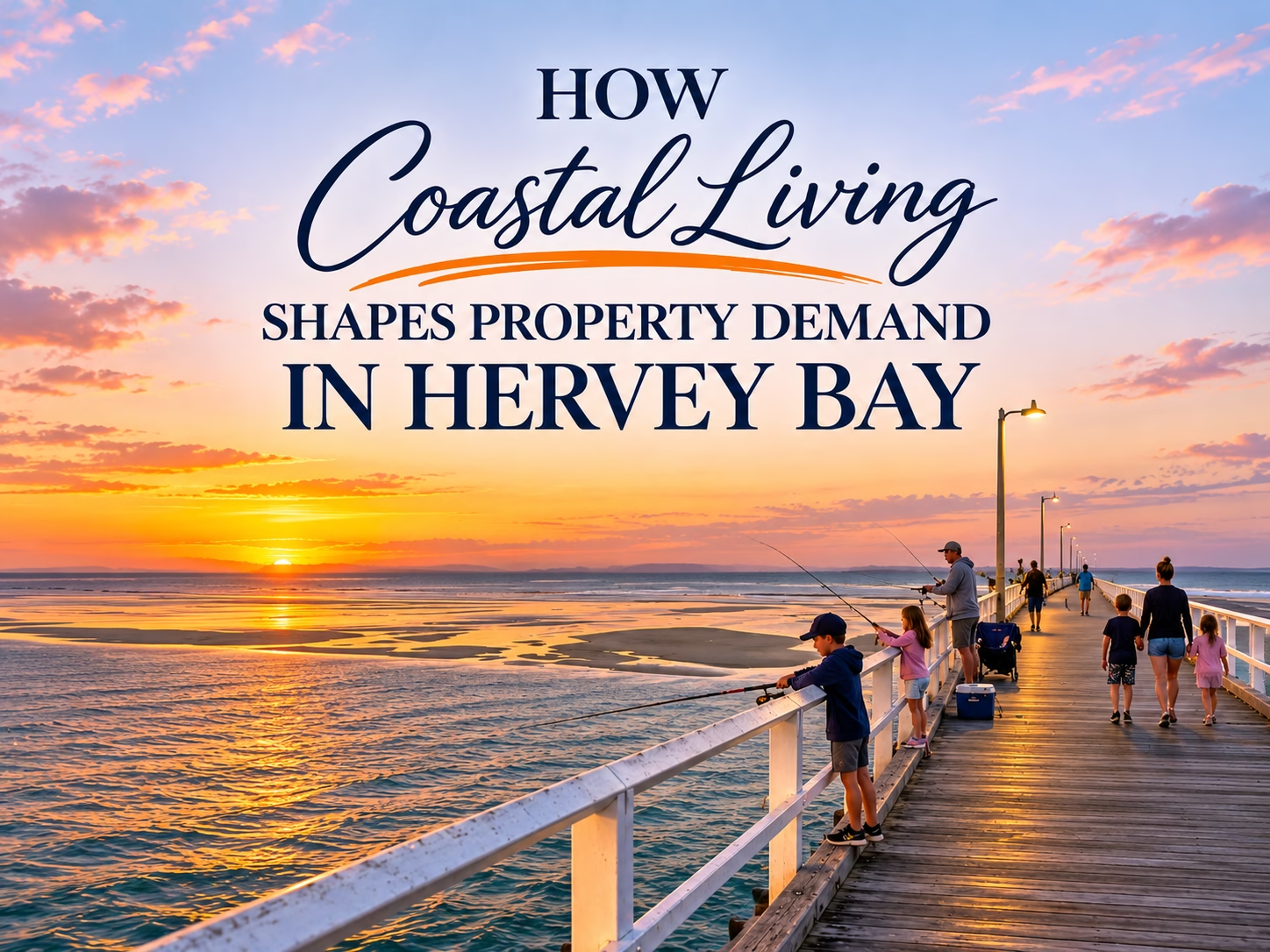
Morning walks beside the water, a coffee along the Esplanade and weekends spent enjoying the outdoors — these everyday experiences are a …
Hervey Bay Property Prices
Number 1 Hervey Bay Real Estate Agent


Hervey Bay property prices are shaped by a combination of coastal lifestyle appeal, local employment, population growth, housing supply, infrastructure, buyer demand and the wider Queensland property market. While prices can move from one period to another, these underlying factors tend to have a much greater influence on the long-term value of homes and land in the area.
Understanding these drivers is more useful than focusing on a single median price or a short-term change. Hervey Bay is a distinctive property market because it combines a regional-city economy with a coastal setting, a substantial retiree and lifestyle market, growing residential areas and access to the broader Fraser Coast region.

Hervey Bay remains a strong and closely watched property market in October 2026, with prices sitting well above where they were a …

The Market Has Changed… But Buyers Are Still Buying There’s no doubt the property market has shifted over the last 3 months. …
Coastal Lifestyle and Location
Location is one of the most important foundations of Hervey Bay property prices. The city offers a coastal lifestyle without the metropolitan scale of Brisbane or the higher density associated with many larger coastal centres. Its beaches, foreshore areas, parks and relatively relaxed environment contribute to demand from people seeking a permanent home as well as those looking for a lifestyle property.
The appeal of the coastline does not affect every property equally. Homes with convenient access to the waterfront, established amenities and attractive streetscapes can command a premium compared with properties that are further from desirable coastal areas. However, buyers generally consider the whole location rather than simply the distance to the beach.
Access to shops, medical services, schools, public transport, recreation and employment can have a significant effect on what buyers are prepared to pay. This creates differences between suburbs and individual streets even when properties appear similar in size.
Population and Household Demand
Population growth is another important driver of property prices. When more people want to live in an area, demand for homes can increase, particularly when new housing supply does not expand at the same pace.
Hervey Bay attracts several different groups of buyers. These include existing Fraser Coast residents moving within the region, retirees seeking a coastal lifestyle, families looking for established housing, investors and people relocating from larger cities or other parts of Queensland.
Different buyer groups also prefer different types of property. Some want low-maintenance homes close to services, while others seek larger family houses, newer dwellings or properties with outdoor space. This diversity helps create multiple segments within the local market rather than one uniform price level.
Retiree and Lifestyle Demand
Hervey Bay has a particularly strong lifestyle and retirement appeal, which is an important characteristic of its housing market. The combination of coastal living, established services and a generally less metropolitan environment makes the area attractive to people who are planning a change in lifestyle.
Retiree demand can influence the types of properties that perform well. Low-maintenance houses, homes in convenient locations and properties close to shopping, healthcare and recreational facilities can attract buyers who place a high value on convenience.
Lifestyle buyers may also have different priorities from investors. A purchaser choosing a home for personal use may be willing to pay more for a particular street, outlook, garden, floor plan or proximity to the waterfront even when those features do not necessarily produce the highest rental return.
Employment and the Local Economy
Property prices ultimately depend partly on the ability of households to afford housing. Local employment and economic conditions therefore matter.
Hervey Bay’s economy is connected to a range of sectors across the Fraser Coast, including health services, education, retail, tourism, construction, public services and other regional industries. The strength and diversity of local employment can support household formation and purchasing power.
A regional property market is also affected by the stability of its economic base. Areas with a broad range of employment opportunities can be more resilient than locations that depend heavily on a single industry. For Hervey Bay, the presence of established services and its role as a significant population centre are important parts of its economic foundation.
Housing Supply and New Development
Supply is one of the most important factors behind property prices. When demand grows faster than the number of suitable homes available for sale, competition between buyers can place upward pressure on prices.
Hervey Bay has experienced residential development, including new subdivisions and housing construction. New development can provide additional supply, but the effect on prices depends on where the new homes are located, what types of dwellings are being built and how quickly they become available.
Land supply is not the same as immediately available housing supply. A large area identified for future development may take years to move through planning, infrastructure provision, subdivision and construction. As a result, the amount of developable land does not automatically mean that buyers have abundant choices today.
Established homes can also retain an advantage because they may already have mature landscaping, completed infrastructure and a known neighbourhood character.
Infrastructure and Accessibility
Infrastructure influences the practical value of a property. Roads, schools, healthcare, shopping centres, public facilities and recreational amenities all contribute to how convenient a location is for everyday life.
Improvements to infrastructure can strengthen particular parts of the market when they make an area easier to access or improve the services available to residents. Conversely, properties affected by difficult access, congestion, noise or other disadvantages may not benefit equally from broader market growth.
The important point is that infrastructure affects property prices through liveability. Buyers are generally paying for a combination of land, dwelling quality, location and access to the services and facilities that make a neighbourhood useful.
Property Type, Land and Dwelling Quality
The price of a Hervey Bay property cannot be understood from location alone. The characteristics of the property itself are also critical.
A renovated house can attract a very different price from an older dwelling requiring substantial work, even if both are on similar blocks. Land size, frontage, building condition, floor plan, number of bedrooms and bathrooms, parking, outdoor areas and construction quality all influence buyer demand.
Land value is especially important because land is a finite component of residential property. Larger blocks may appeal to buyers who want gardens, sheds, additional parking or future flexibility, while smaller lots can attract buyers who prefer lower maintenance.
The relationship between land and improvements varies across different parts of Hervey Bay. That is why comparing properties solely by their headline sale price can be misleading.
Interest Rates and Borrowing Capacity
Hervey Bay is not isolated from national financial conditions. Interest rates and lending standards influence how much many buyers can borrow and therefore what they can afford to pay.
When borrowing costs rise, some households reduce their budgets, delay purchasing or look at less expensive properties. When financing conditions become more favourable, purchasing power can increase.
This effect can be particularly important in markets where a significant proportion of buyers rely on mortgages. However, interest rates are only one part of the picture. Local supply, population changes, employment, construction costs and buyer preferences continue to influence prices at the same time.
Construction Costs and Replacement Value
The cost of building a new home also affects the broader housing market. Labour, materials, land development and infrastructure costs all contribute to the total cost of producing new housing.
If construction becomes more expensive, newly built homes may require higher selling prices to make development financially viable. This can influence the relationship between new and established properties.
Construction costs can also affect renovation decisions. When rebuilding or substantially improving a home becomes expensive, buyers may place greater value on properties that are already well maintained or recently renovated.
Suburb and Street-Level Differences
One of the most important things to understand about Hervey Bay property prices is that the market is not uniform. Prices can vary considerably between suburbs, neighbourhoods and even individual streets.
Proximity to the waterfront, shopping, schools, medical facilities and major roads can influence demand. So can flood exposure, traffic, noise, views, block shape, surrounding development and the condition of neighbouring properties.
Two houses with similar floor areas may therefore have very different market values. A property valuation or comparable-sales analysis needs to account for these differences rather than relying on a broad city-wide figure.
What Drives Long-Term Value?
For anyone assessing Hervey Bay property prices over the long term, the most useful approach is to consider several factors together. Population and household growth influence demand. Employment and services support the ability and willingness of people to live in the region. Land availability and construction activity influence supply. Coastal lifestyle appeal supports buyer interest, while infrastructure and neighbourhood quality affect the desirability of particular locations.
The strongest properties are not necessarily those with the largest houses or the biggest blocks. Long-term demand tends to favour properties that combine useful housing characteristics with a location that remains attractive to a broad range of buyers.
A Market Shaped by Multiple Forces
Hervey Bay property prices are best understood as the result of interacting forces rather than a single trend. Coastal appeal creates lifestyle demand, population changes add or reduce pressure on housing, local employment supports purchasing power, and development determines how quickly additional homes can be supplied.
Financial conditions can change the amount buyers are able to spend, while infrastructure, neighbourhood characteristics and property quality determine which homes attract the strongest competition.
These underlying drivers provide a more durable way to understand the Hervey Bay property market. Individual prices will always vary according to the property and the circumstances of a sale, but the fundamentals of location, demand, supply, affordability, employment, infrastructure and liveability remain central to how residential property values are formed over time.