
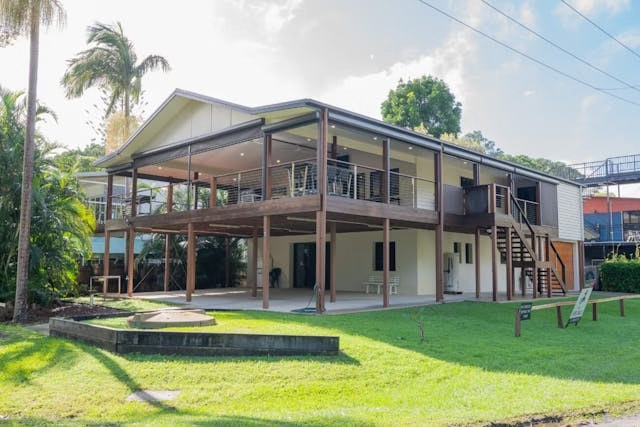
The Queensland property market in May 2026 reflects a mature phase of the growth cycle, characterised by more balanced conditions compared to the rapid acceleration seen earlier in the decade. Rather than a single unified trend, the market operates in distinct segments, with Hervey Bay and South East Queensland behaving differently from regional centres and resource-linked towns.
Overall, demand remains supported by ongoing interstate migration, particularly into Brisbane and coastal lifestyle regions. However, affordability constraints and higher borrowing costs compared to the early 2020s have moderated the pace of price growth. Sellers in many areas are finding that expectations need to be more closely aligned with current buyer capacity, while buyers have gained slightly more negotiating power compared to the peak conditions of previous years.
Economic Factors Shaping the Market
Interest rates remain one of the most influential drivers of property activity in 2026. Although rates have stabilised compared to earlier tightening periods, the cumulative effect of higher borrowing costs continues to impact serviceability assessments for buyers. This has reduced borrowing capacity for many households, particularly first-home buyers and highly leveraged investors.
Inflationary pressures, while easing compared to peak levels earlier in the decade, have left a lasting imprint on household budgets and construction inputs. These cost pressures have contributed to elevated new-build prices, which in turn has supported demand in established housing markets where buyers perceive better relative value.
Employment conditions in Queensland remain comparatively strong, with population growth continuing to underpin labour demand across construction, healthcare, education, and hospitality sectors. This employment stability provides a floor for housing demand even in periods of reduced affordability.
Brisbane Housing Market Trends
Brisbane continues to act as the central anchor of the Queensland property market. In May 2026, the city exhibits moderate but steady price movements rather than the rapid growth phases seen in earlier years. Inner-city suburbs with strong infrastructure access, river proximity, and lifestyle amenities remain highly competitive, although clearance rates have normalised compared to peak demand periods.
Medium-density housing, including townhouses and apartments, has gained increased attention due to affordability constraints in detached housing markets. This shift reflects changing buyer behaviour, particularly among younger households and downsizers who prioritise location and amenity over land size.
Infrastructure development, including transport upgrades and precinct renewal projects, continues to support long-term confidence in Brisbane’s property market. However, the immediate impact of these projects is more gradual, with benefits distributed unevenly across suburbs depending on proximity and accessibility improvements.
Gold Coast and Sunshine Coast Dynamics
The Gold Coast and Sunshine Coast remain two of the strongest lifestyle-driven markets in Queensland. Both regions continue to attract interstate migration, particularly from New South Wales and Victoria, as well as from within Queensland itself.
On the Gold Coast, demand is particularly strong in coastal and near-coastal suburbs, where limited land supply constrains new development. This has contributed to sustained price resilience, even in the face of higher interest rates. However, affordability challenges are increasingly shaping buyer composition, with greater participation from high-income earners and downsizers.
The Sunshine Coast continues to benefit from infrastructure investment and population inflows, with steady demand across both detached homes and lifestyle acreage properties. While growth has moderated compared to earlier expansion phases, the region remains structurally undersupplied in certain housing segments, particularly affordable family homes.
Both coastal regions are also experiencing increased pressure on rental markets, driven by population growth and limited short-term accommodation conversion capacity. This has supported rental yields in many suburbs, attracting continued investor interest despite broader financing constraints.
Regional Queensland and Resource Towns
Regional Queensland presents a more mixed picture in May 2026. Mining-linked towns experience cyclical demand patterns influenced by commodity prices and resource sector employment. When resource activity is strong, these areas can see rapid increases in both housing prices and rental demand. However, they remain more volatile than South East Queensland markets.
Agricultural regions tend to exhibit more stable but slower growth patterns, with demand closely tied to local employment conditions and generational property ownership transfer. Housing affordability in these areas is generally higher than in coastal cities, but liquidity in the market can be lower due to smaller buyer pools.
Some regional centres continue to benefit from decentralisation trends, where households and businesses seek lower-cost alternatives to major metropolitan areas. Improved digital connectivity and hybrid working arrangements have supported this gradual shift, although it remains less pronounced than during peak pandemic-era migration.
Supply Constraints and Construction Activity
Housing supply remains a central issue across Queensland in 2026. Construction activity has been constrained by labour shortages in the building industry and elevated material costs, both of which have persisted from earlier economic disruptions. As a result, new housing completions have struggled to keep pace with population growth in high-demand regions.
This supply-demand imbalance is most visible in South East Queensland, where land availability, planning approvals, and infrastructure constraints limit rapid expansion. In established suburbs, infill development and redevelopment projects have become more common, although these are often slower and more complex to deliver.
Apartment construction has shown signs of recovery in certain inner-city areas, but investor caution and financing constraints have tempered large-scale high-rise development compared to previous cycles. Builders and developers continue to focus on smaller, more targeted projects that align more closely with current buyer demand.
Investor Activity and Rental Market Conditions
Investor participation in the Queensland property market remains present but more selective in 2026. Higher interest rates compared to earlier years have reduced aggressive leveraged investment strategies, leading to a more cautious approach focused on cash flow and long-term capital growth potential.
Rental markets across major Queensland cities remain tight, particularly in Brisbane and coastal regions. Vacancy rates in many suburbs remain low, supporting upward pressure on rents. This has improved yield attractiveness in some segments, partially offsetting higher borrowing costs for investors.
However, regulatory considerations, insurance costs in certain coastal areas, and ongoing maintenance expenses have made investment decisions more complex. Investors are increasingly prioritising properties with strong rental demand fundamentals rather than speculative growth expectations.
Affordability and Buyer Behaviour
Affordability continues to be one of the defining challenges of the Queensland housing market in May 2026. While Queensland remains relatively more affordable than Sydney or parts of Melbourne, price growth over the past decade has reduced accessibility for entry-level buyers in many desirable locations.
First-home buyers are increasingly concentrating in outer suburban corridors or smaller dwelling types, including units and townhouses. Government incentives and lending programs continue to play a role in supporting this segment, although they do not fully offset broader affordability pressures.
Buyer behaviour has also shifted toward greater due diligence, with increased sensitivity to interest rate changes, insurance costs, and long-term holding expenses. This has resulted in longer decision-making cycles compared to more speculative market phases.
Outlook for the Remainder of 2026
Looking beyond May 2026, the Queensland property market is expected to remain relatively stable, with modest growth in most regions rather than sharp increases or declines. Continued population growth is likely to provide underlying demand support, particularly in South East Queensland.
However, the pace of growth is expected to remain moderated by affordability constraints and financing conditions. Markets with strong infrastructure investment, limited housing supply, and high lifestyle appeal are likely to outperform, while more supply-rich or economically sensitive regions may experience flatter conditions.
Overall, Queensland’s property market in 2026 reflects a transition toward equilibrium, where long-term fundamentals such as population growth and geographic appeal remain strong, but short-term price dynamics are more closely tied to economic conditions and buyer capacity than in previous high-growth phases.